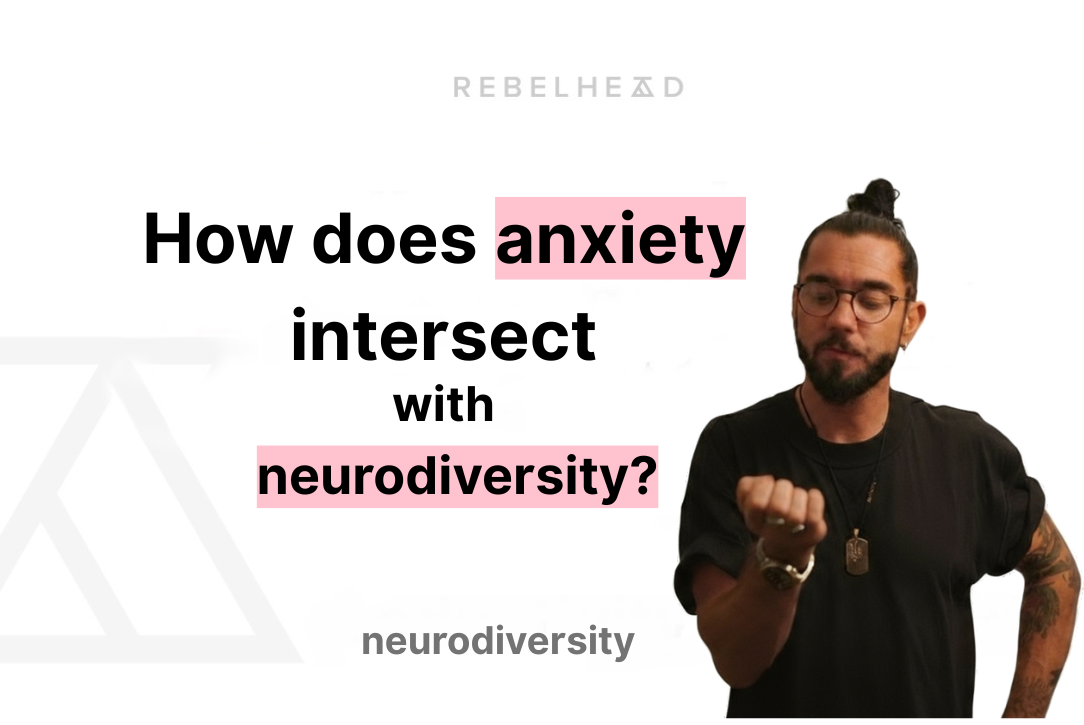
(Why it’s common, misunderstood, and not a personal failing)
Anxiety is often talked about as a standalone condition. Something you either “have” or “don’t have.” Something to manage, reduce, or eliminate. Breathe deeply. Drink water. Think positive thoughts.
But for many neurodivergent people, anxiety isn’t a random visitor.
It’s more like a background app that’s been running quietly for years, draining the battery.
To understand anxiety in neurodivergent lives, we have to stop asking,
“Why are you anxious?”
and start asking,
“What has your nervous system been dealing with every day?”
Anxiety isn’t separate from neurodiversity
For autistic, ADHD, dyslexic, dyspraxic, and otherwise neurodivergent people, anxiety often develops because of how the world responds to their brains, not because their brains are inherently anxious.
Many neurodivergent people grow up experiencing:
- Sensory overload
- Constant misunderstanding
- Pressure to behave “normally”
- Repeated correction or criticism
- Environments that don’t fit how they process information
Over time, the nervous system learns one thing very clearly:
Stay alert. Something could go wrong.
That’s anxiety. Not weakness. Not overthinking. Adaptation.
Masking: the anxiety amplifier
One of the biggest intersections between anxiety and neurodiversity is masking.
Masking is the effort to hide or suppress neurodivergent traits in order to appear acceptable, professional, calm, or “normal.”
It can look like:
- Forcing eye contact
- Rehearsing conversations in advance
- Suppressing stimming or movement
- Monitoring tone, facial expression, posture
- Overworking to compensate for struggles
Masking is often learned early and reinforced socially.
And it comes at a cost.
Constant self-monitoring keeps the nervous system in a state of vigilance. Over time, this can lead to chronic anxiety, burnout, and even physical illness.
You’re not anxious because you’re bad at coping.
You’re anxious because you’ve been coping all the time.
Sensory anxiety: when the environment feels unsafe
For many neurodivergent people, anxiety isn’t abstract. It’s sensory.
Bright lights. Loud noises. Unpredictable movement. Strong smells. Crowded spaces. These can all trigger a stress response before a person has consciously “felt anxious.”
The body reacts first.
Heart rate increases. Muscles tense. Focus narrows.
This is especially common when sensory overload has been repeatedly ignored or dismissed in the past. The nervous system learns to anticipate overwhelm and goes into protective mode early.
That’s not irrational fear.
That’s pattern recognition.
Uncertainty, change, and cognitive load
Many neurodivergent brains rely on predictability to feel safe and regulated. Unexpected changes, vague instructions, or unclear expectations can create anxiety fast.
Not because the person can’t cope with change, but because:
- Processing takes more effort
- Working memory may be overloaded
- Past experiences have taught them that surprises often equal stress
Anxiety here isn’t about control.
It’s about reducing cognitive load so the brain can function without being overwhelmed.
Clear communication, routines, and advance notice aren’t preferences. They’re supports that lower anxiety at a neurological level.
Social anxiety and misunderstanding
Social anxiety is common in neurodivergent people, but not for the reasons often assumed.
It’s not always about fear of people.
It’s about fear of being misunderstood, corrected, judged, or punished for doing something “wrong” without knowing what that wrong thing is.
When social rules feel invisible, inconsistent, or unspoken, anxiety becomes a survival strategy.
Hypervigilance isn’t personality.
It’s learned safety behaviour.
Anxiety can look different in neurodivergent people
Neurodivergent anxiety doesn’t always look like panic attacks or constant worry. It can show up as:
- Irritability
- Shutdown or withdrawal
- Procrastination or avoidance
- Physical symptoms (headaches, stomach issues, fatigue)
- Perfectionism
- Over-preparing or overworking
This is why neurodivergent anxiety is often missed, misdiagnosed, or misunderstood.
Especially in adults who have spent years “functioning” while quietly struggling.
The double bind: anxiety about being anxious
Many neurodivergent people are told their anxiety is the problem. That they need to calm down, try harder, or think differently.
But when anxiety is rooted in real neurological and environmental stressors, this message can increase shame and self-blame.
You end up anxious about your anxiety.
And that spiral is exhausting.
Support doesn’t start with asking someone to be less anxious.
It starts with asking what their nervous system needs.
Supporting anxiety through a neurodiversity lens
When anxiety intersects with neurodiversity, the most effective supports are often environmental and relational, not just internal.
Helpful approaches include:
- Reducing sensory overload
- Increasing predictability and clarity
- Allowing movement, stimming, and rest
- Offering flexible working or learning options
- Validating experiences rather than minimising them
- Addressing masking and burnout, not just symptoms
Therapeutic approaches can also help, but they work best when adapted to neurodivergent processing styles rather than assuming a one-size-fits-all model.
Anxiety isn’t a flaw. It’s information.
Anxiety tells us something is too much, too fast, too loud, too unclear, or too unsafe for the nervous system.
In neurodivergent people, anxiety often makes perfect sense when viewed in context.
It’s not a character defect.
It’s not a lack of resilience.
It’s not something to “push through.”
It’s a signal.
Compassion changes everything
When we understand how anxiety intersects with neurodiversity, the narrative shifts.
From:
“Why are you like this?”
To:
“Of course you’re anxious. Look at what you’ve been navigating.”
That shift creates space for compassion, accommodation, and real support.
And when neurodivergent people are supported in ways that respect their nervous systems, anxiety doesn’t disappear overnight, but it softens.
Not because they were fixed.
But because they were finally understood.
Links:
Popular Articles: